
Frequently Asked Questions
General Questions
Which left handed instruments do you stock?
We carry a large range of left handed instruments.
Fine Scissors 14160-10 and 14161-10
Surgical Scissors 14008-14
Utility Scissors 37000-00
Halsted-Mosquito Hemostats 13108-12 and 13109-12
Olsen-Hegar Needle Holders 12102-12 and 12512-12
Crile-Wood Needle Holder 12504-15
Ligation Aid 18063-13
I have two of the same instrument and they differ slightly?
High quality surgical instruments which are handmade can lead to some minor variations in the dimensions of instruments, particularly between manufacturing batches. This is sometimes evident in the fine spring scissors range and the tips of Dumont forceps.
What are the finest instruments you stock?
Finest Spring Scissors
Vannas Spring Scissors (15000-03 & 15000-04)
Vannas Spring Scissors (15000-00 & 15000-10)
Moria Spring Scissors (15396-00 & 15396-01)
Vitrectomy Scissors (15036-14 & 15037-14)
Finest Forceps
Dumont Forceps (11252-00)
Dumont Forceps (11254-20)
Dumont Forceps (11295-20)
Moria Forceps (11370-40 & 11370-42)
Moria Forceps (11399-80 & 11399-87)
Finest Rongeurs
Friedman-Pearson Rongeurs (16220-14 & 16221-14)
Finest Retractor
Mini-Goldstein Retractor (17002-02)
Finest Microknife
Diamond Knives (10100-30 & 10100-45)
What are FST Hand Crafted products?
FST surgical mechanics refine and perfect these instruments in FST’s own workshop, making many of the FST hand crafted products unique in the world. Look for the FST HAND CRAFTED LABEL.
Products and Alloys
What material are the black and green forceps made from?
Item No. 11626-11, which is a pastel green is Inox with a Teflon coating. Item No. 11220-21, which is a regular green hue is Inox coated with epoxy. Item Nos. 11252-50 and 11272-50 are both Inox coated with ceramic. Item No. 11215-02 is carbon steel coated with epoxy.
Why do certain scissors have black handles?
Scissors with black handles means they are ToughCut®.
ToughCut® scissors feature two unique cutting edges that cut through the toughest tissue
with exceptional ease and accuracy. One blade is honed to razor sharpness, and the other
is micro-serrated to minimize tissue slippage during cutting.
Why do some instruments have gold handles?
Instruments with gold handles means they are made with tungsten carbide.
Tungsten carbide is one of the hardest alloys available and lasts almost two times longer than stainless steel. Tip inlays are either glued or welded into place. For needle holders, tips can be made with a pyramid cross pattern that holds suture needles much more securely.
Compare the extra cost of these instruments with the length of useful wear, and you have a
cost effective solution for your instrument requirements.
Stainless steel is an alloy, which does exactly what its name implies: stains less than ordinary steel (iron). Yes, it can stain, discolor and rust, given the right circumstances.
To make iron stainless, nickel and chromium are added in certain quantities, depending on the purpose it is being used for and the quality required. The more chromium added to the mix, the softer the alloy becomes, something not desirable in a surgical instrument. Given that, quality medical stainless steel alloy is of a very specific, narrowly defined mix.
A further aspect of making steel “stain less” is a repeated process of extracting surface impurities, mainly minerals. And the final high polish of the finished instrument puts a minute protective coating on it, also very important to make the instrument “stain less”. Whether the final product is highly polished or matte finished will make no difference in its stainless ability.
Why choose a Titanium Instrument?
Titanium instruments are over 40% lighter than equivalent stainless steel instruments, with better flexibility and strength. Elemental titanium (Ti) is a very strong, lustrous, white metal with a specific gravity of 4.54. Titanium and titanium alloys readily form stable protective surface layers, giving them excellent corrosion resistance to saltwater, laboratory saline solutions, blood and other bodily fluids, oxidizing acids, alkalis and chlorides.
Titanium is 100% nonmagnetic; a great benefit when working with nerves. Its inherent surface oxide film provides bactericidal and non-allergenic properties. Titanium alloys can be heated up to 440°C (824°F).
What are the benefits of a ceramic coating?
One of the hardest materials on Earth, ceramic is used in surgical instruments to form edges that
last longer than stainless steel and even longer than tungsten carbide. Ceramic also has a high slide capacity which reduces surface tension and results in a much cleaner cut than metal instruments.
Our CeramaCut® scissors combine ToughCut® technology with Tungsten Carbide edges and a ceramic coating for one of the best, cleanest cutting scissors available on the market today.
What are the benefits of the different alloys?
The cutting life is more than doubled with the addition of ToughCut blades to stainless steel, and over six times longer with CeramaCut blades.
- Tungsten Carbide lasts 1.9x longer than stainless steel
- Stainless Steel with ToughCut lasts 2.3x longer than stainless steel
- Tungsten Carbide with ToughCut lasts 4.1x longer than stainless steel
- CeramaCut (Ceramic Coated Tungsten Carbide with ToughCut) lasts 6.6x longer than stainless steel
Dumont
Are forceps / Tweezers different from each other?
Forceps and tweezers are interchangeable words. Both words describe the same product.
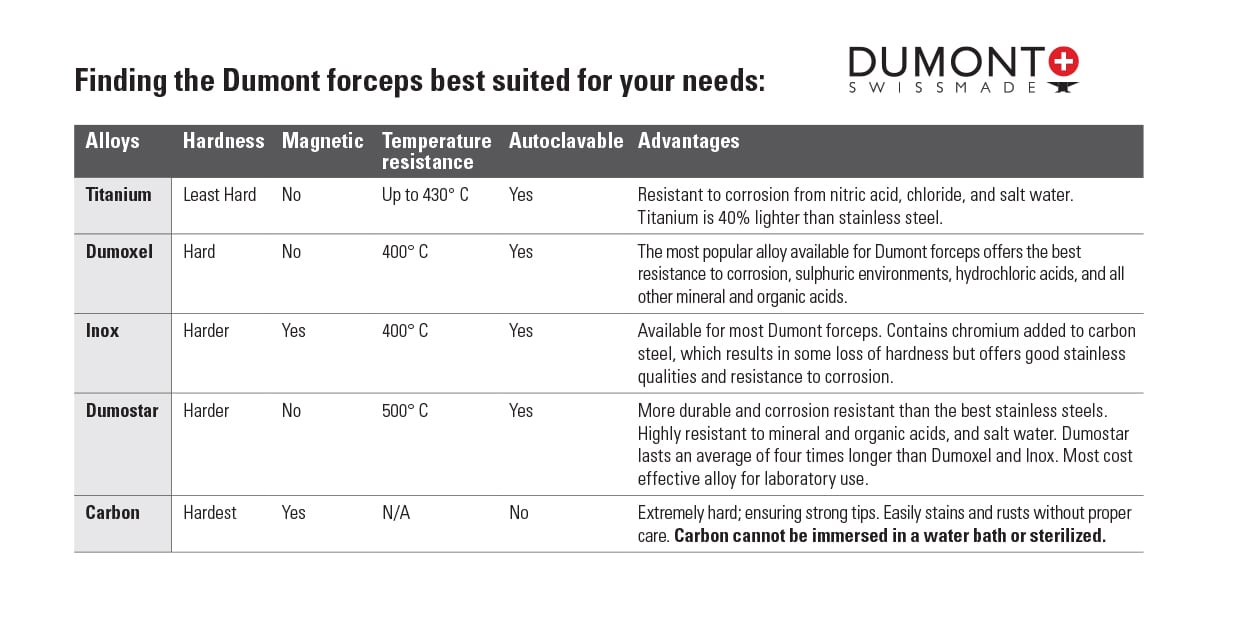
Can you explain the different Dumont alloys?
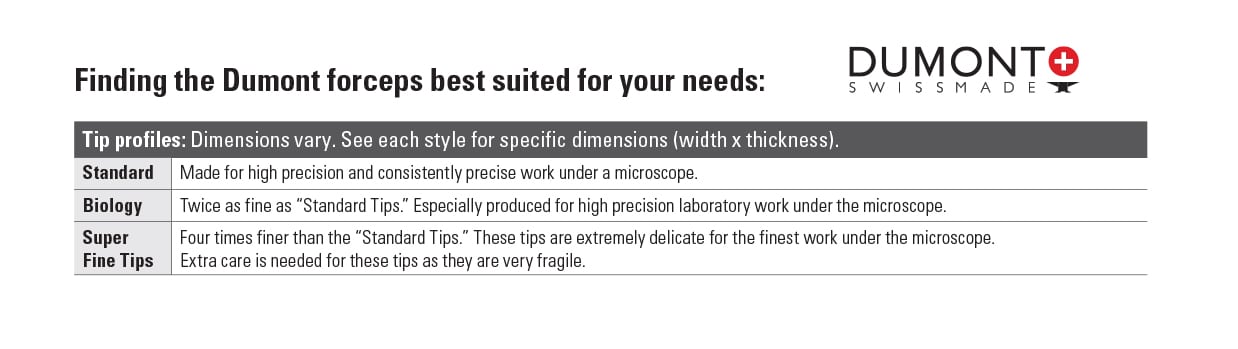
Can you explain the different tip options?
How can I protect the tips of my forceps and prolong their life?
We stock accessories that aid in the care and maintenance of your delicate Dumont Forceps.
Below are some items that can be used to prolong the life of your forceps tips.
Dumont Forceps Repair Kit (29000-00)
Sharpening Stone (29008-22)
Tip Protectors (29060-00)
O-rings (11200-00)
Ordering, Delivery and Quotations
Are prices shown excluding VAT?
Yes. Product prices are shown excluding VAT. VAT is added where applicable during checkout and is shown separately on formal quotations.
Can I create a formal quotation or order using a purchase order?
Yes. Sign in to your account, add products to your current quotation and save it to download a branded PDF for approval. When your purchase order is ready, load the saved quotation, add it to the basket and choose the purchase-order route at checkout. See the purchase orders, quotations and VAT relief guide.
What are the standard UK delivery charges?
Standard UK delivery is £4.95 for orders below £100 and free for orders of £100 or more. Any available delivery methods and charges are confirmed during checkout.
What happens if an item is not currently in stock?
Availability can vary by product. Contact G&A Scientific with the product code and required quantity for the latest lead-time estimate or help finding a suitable alternative.
Can I return an instrument if it is unsuitable?
Contact G&A Scientific before sending any item back. The team will confirm whether it is eligible for return and provide the current return instructions. Eligibility may depend on the product, its condition and whether it has been used or processed.
Product Use and Specifications
Are Fine Science Tools products intended for use on humans?
No. Products in the Fine Science Tools range are intended for research laboratories and veterinary use only and are not intended for use on or in humans.
Are instruments supplied sterile?
Do not assume that an instrument is sterile. Check the Sterile field on the individual product page and the product-specific instructions. If the specification is unclear, contact G&A Scientific with the product code before use.
How can I tell whether an instrument is autoclavable?
Check the individual product specification, feature badges and current product instructions. Some materials, coatings and components are not suitable for autoclaving. The instrument cleaning, sterilisation and care guide provides general guidance, but the product-specific instructions and your organisation’s validated procedures take priority.
What do pack size and unit of measure mean?
Pack size states how many items are supplied together. Unit of measure explains how the product is sold, for example each, pack or box. Check both fields on the product page before ordering, particularly for consumables and replacement parts.
Can G&A Scientific help me select products from an instrument list or application?
Yes. Send the team your product codes, existing instrument list or a description of the required functions. G&A Scientific can help compare specifications and identify suitable catalogue options; final suitability and validated use remain the customer’s responsibility.
Repairs and Replacement Parts
Which instruments can be repaired or sharpened?
Many scissors, forceps, needle holders and other precision instruments can be assessed for sharpening, alignment, repair or reconditioning. Suitability depends on the instrument and its condition. Contact the team before sending anything and see Service and Support for the current process.
Can I order replacement parts for Fine Science Tools systems?
Replacement parts are available for selected systems and instruments. Search using the main product code or contact G&A Scientific with the system name and existing part number so compatibility can be checked before ordering.